Why Home Solar with Battery Storage is a Smart Investment
The economic case for residential solar-plus-storage has strengthened dramatically over the past decade. According to the National Renewable Energy Laboratory, the average cost of installed solar dropped from $7.50 per watt in 2010 to under $2.80 per watt in 2024, while lithium-ion battery prices fell by nearly 90% during the same period. This convergence of declining costs and rising electricity rates—which have grown an average of 4.3% annually since 2000—creates a compelling payback scenario. Homes with battery storage can shift up to 70% of their electricity consumption to solar-generated power, reducing grid dependence by a comparable margin. More critically, battery systems provide resilience against grid outages, which the U.S. Energy Information Administration reports have increased in frequency by 67% since 2015. When utility rates incorporate time-of-use pricing, a properly sized battery can arbitrage between high and low rate periods, saving homeowners an additional 15-25% annually.
Key Components of an Efficient Solar and Battery System
An efficient system requires careful selection of four interdependent components: photovoltaic panels, inverter technology, battery chemistry, and monitoring software. Monocrystalline panels, which achieve 20-23% efficiency, outperform polycrystalline alternatives by 3-5 percentage points, justifying their higher upfront cost. The inverter—the system's "brain"—has evolved from string inverters to microinverters and power optimizers; microinverters typically improve energy harvest by 5-10% in partially shaded conditions. Battery chemistry presents a trade-off between lithium iron phosphate (LFP), which offers 4,000-6,000 cycles but has lower energy density, and nickel manganese cobalt (NMC), which provides higher density but degrades faster at high temperatures. The table below compares typical residential configurations:
| Component | Entry-Level | 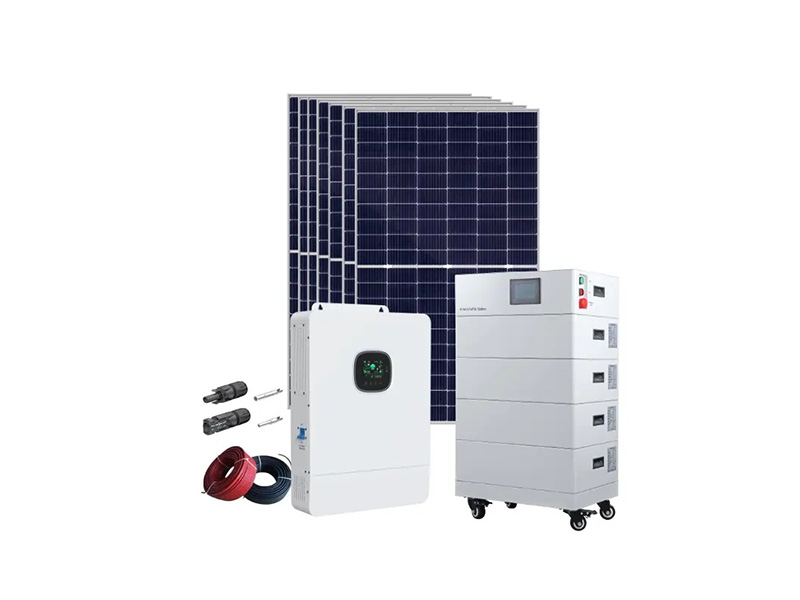 Key components of a solar and battery system, including panels, inverter, and storage. |
|---|
Proper sizing begins with a 12-month analysis of household consumption, typically 900-1,200 kWh per month for an average American home. Solar array sizing should target 100-110% of annual consumption to account for inverter losses and panel degradation. Battery capacity requires different logic: rather than matching daily consumption, the optimal battery size typically covers 60-80% of evening and peak-hour usage, which for most homes equals 10-15 kWh of usable capacity. Over-sizing batteries beyond this threshold yields diminishing returns, as the marginal cost per kWh of storage capacity rises sharply. Orientation and tilt optimization can boost output by 15-20%: south-facing panels at a 30-35 degree tilt capture maximum annual irradiance in northern latitudes. Smart load management—scheduling high-consumption appliances like electric water heaters and EV chargers during solar production hours—can increase self-consumption ratios from 35% to 60% without additional hardware.
The total installed cost for a typical 8 kW solar system with 13.5 kWh battery ranges from $25,000 to $35,000 before incentives. Federal tax credits cover 30% of this cost, reducing the net figure to $17,500-$24,500. State-level incentives vary considerably: California's Self-Generation Incentive Program offers $200/kWh for battery storage, while Massachusetts provides up to $4,000 per installation. Net metering policies—available in 38 states—allow homeowners to sell excess generation back to utilities, accelerating payback periods to 6-9 years in favorable jurisdictions. When factoring in the avoided cost of backup generators (typically $5,000-$10,000) and potential property value increases of 4-6%, the net present value of a solar-battery system over 25 years ranges from $15,000 to $40,000, depending on local electricity rates and solar irradiance.
Frequently Asked Questions (FAQ)
Q: What is the average payback period for a home solar-plus-storage system?
A: The payback period varies, but with solar costs down to $2.80 per watt and battery prices falling 90%, most homes see payback in 5-10 years, depending on electricity rates and usage.
Q: How much of my electricity can a home battery system offset?
A: A properly sized battery can shift up to 70% of your electricity consumption to solar power, reducing grid dependence by a similar margin and saving an additional 15-25% with time-of-use pricing.
Q: What are the key differences between LFP and NMC battery chemistries?
A: LFP batteries offer 4,000-6,000 cycles and lower energy density, while NMC has higher density but degrades faster at high temperatures. LFP is often preferred for longevity.
Q: How do I determine the right battery size for my home?
A: The optimal battery size covers 60-80% of evening and peak-hour usage, typically 10-15 kWh for average homes. Oversizing beyond this yields diminishing returns.
Q: What is the efficiency difference between microinverters and string inverters?
A: Microinverters improve energy harvest by 5-10% in partially shaded conditions compared to string inverters, justifying their higher cost for many installations.