
The Rise of Off-Grid Container Farming
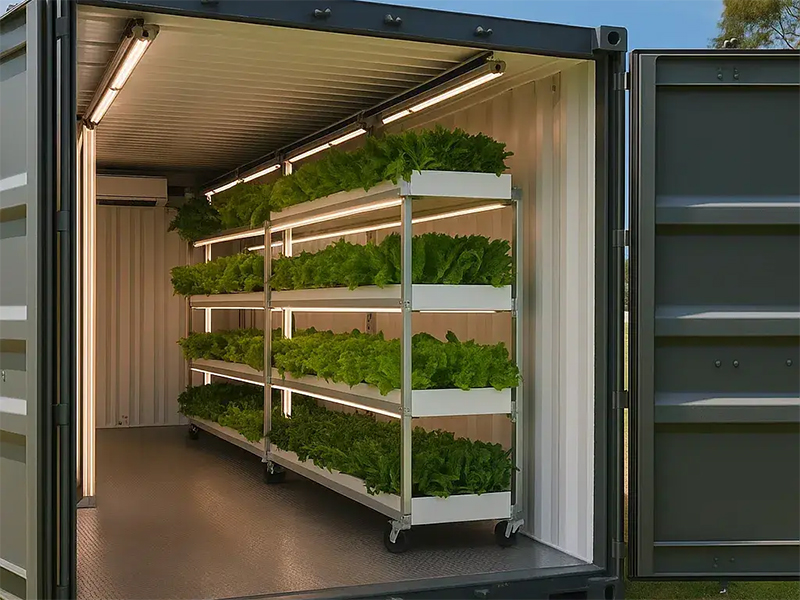
Conventional agriculture consumes approximately 70% of global freshwater and contributes nearly 24% of greenhouse gas emissions. In response, container farming—repurposed shipping containers equipped with hydroponic or aeroponic systems—has gained traction as a controlled environment agriculture (CEA) solution. However, grid dependence has historically limited deployment in remote or disaster-affected regions. OEM factories have now solved this bottleneck by Solar-Powered Container Farming Systems, creating fully autonomous growing units that operate independently of local power infrastructure. This convergence of solar engineering and precision agriculture marks a significant step toward decentralized food production.
Engineering the System: Solar Integration and Container Design
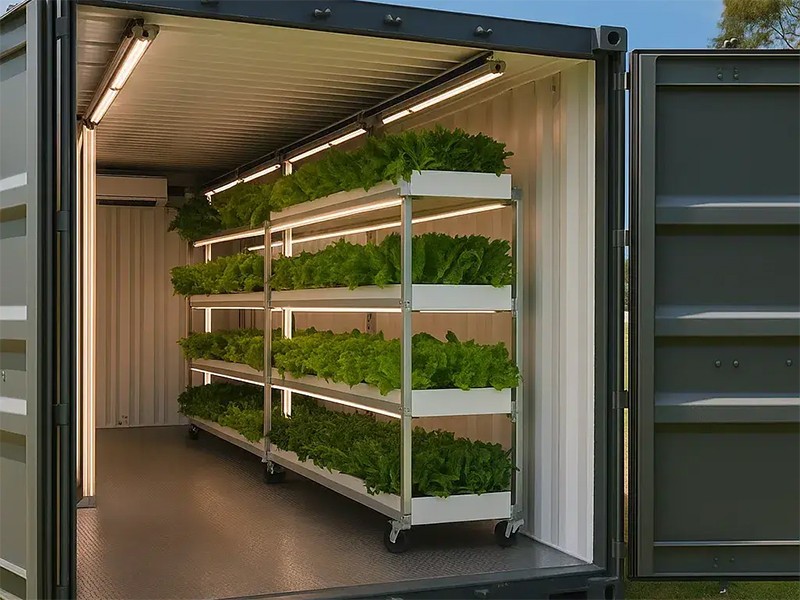
OEM-manufactured Solar Container Farming systems employ a dual-axis solar tracking array mounted on reinforced roof rails, typically generating 8–12 kW per container depending on latitude and panel efficiency. The container itself—standardized at 20 or 40 feet—undergoes structural reinforcement to support panel weight while maintaining thermal insulation (R-value ≥ 30). Key electrical components include lithium-iron-phosphate batteries (15–30 kWh) paired with hybrid inverters, enabling seamless switching between solar input and stored energy. Smart load-shedding algorithms prioritize power for LED lighting, HVAC, and irrigation pumps, while reducing non-essential loads during overcast periods. The table below summarizes typical specifications for a 40-foot unit:
| Parameter | Specification | Unit |
|---|---|---|
| Solar Capacity | 12.5 | kWp |
| Battery Storage | 28.6 | kWh |
| Daily Yield (Leafy Greens) | 45–60 | kg |
| Energy Self-Sufficiency | 92–97 | % |
| Water Recycling Rate | 98 | % |
| Operating Temperature Range | -20 to 45 | °C |
Year-Round Cultivation: Climate Control and Crop Management
Achieving continuous production requires precise microclimate management, even when external temperatures swing dramatically. The system employs multi-stage HVAC with heat recovery ventilators, maintaining internal conditions at 18–24°C with 65–75% relative humidity. CO₂ supplementation (up to 1200 ppm) is generated by a combustion-free catalytic converter, enhancing photosynthetic efficiency by 25–30% compared to ambient levels. LED spectra are tuned per crop stage: blue-dominant light (450 nm) for vegetative growth, red-dominant (660 nm) for flowering and fruiting. Automated nutrient dosing adjusts pH and electrical conductivity in real-time via sensors feeding a central PLC controller. For crops like lettuce, the entire cycle—from seeding to harvest—takes 28–35 days, enabling 12–13 harvest cycles annually regardless of external seasonality.
Economic and Environmental Benefits of OEM Solar-Powered Container Farming
OEM procurement offers distinct cost advantages over piecemeal retrofitting. Factory-built systems reduce installation time by 60% and lower upfront capital expenditure by 15–20% due to economies of scale. Operational expenses drop dramatically: solar energy eliminates fuel costs, while water recycling cuts usage by 90% compared to field agriculture. Environmentally, each container sequesters approximately 36 tons of CO₂ equivalent annually when displacing trucked produce, while eliminating pesticide runoff entirely.