
Why Homeowners Need Solar Battery Storage
The economics of residential solar battery storage system have fundamentally shifted. A decade ago, net metering allowed homeowners to sell excess daytime generation back to the grid at retail rates. Today, over 40 U.S. states have revised or are revising those policies, with compensation often dropping to wholesale levels. This divergence creates a stark financial case: storing your own solar energy for evening use yields up to three times the value of exporting it. Beyond economics, battery storage provides resilience against grid outages, which the U.S. Energy Information Administration reports have doubled in frequency since 2017. For homes in fire-prone or hurricane-affected regions, this backup capability transforms a solar array from a mere bill-reduction tool into a critical infrastructure asset.
Core Components of a Residential Battery System
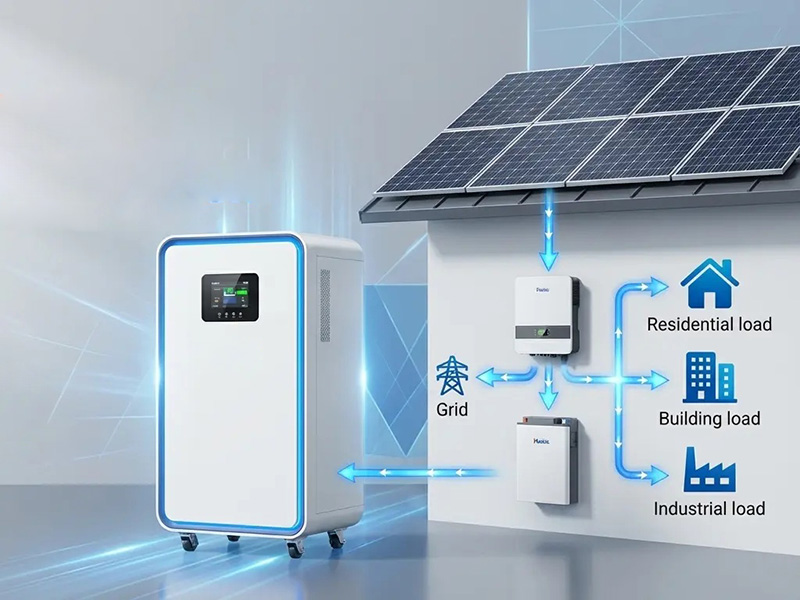
A functional residential battery system comprises four elements. The lithium-iron-phosphate (LFP) battery cells form the energy reservoir, typically arranged in modules of 10-15 kilowatt-hours. The hybrid inverter performs dual duty—converting DC from panels and battery to AC for home use, with efficiencies now exceeding 97%. A battery management system (BMS) monitors cell voltage, temperature, and state of charge, executing balancing algorithms that directly determine cycle life. Finally, the energy management controller decides when to charge, discharge, or grid-import based on time-of-use rates and load forecasts.

How OEM Direct Reduces Costs and Increases Reliability
Purchasing directly from an original equipment manufacturer (OEM) eliminates a two-tier distribution chain . A typical residential PV storage system with installation currently runs $1,000-$1,300 per kilowatt-hour installed. By bypassing distributors and regional wholesalers, OEM-direct buyers commonly achieve $800-$950 per kilowatt-hour—a saving of 20-30%. For a 13.5 kWh system, the difference represents $2,700-$4,700 in upfront savings.
Reliability also improves because OEMs provide firmware updates, warranty claims, and technical support directly. Most reputable OEMs now offer 10-year performance warranties guaranteeing 70% capacity retention, with direct replacement logistics rather than depot repairs.
Choosing the Right Battery Capacity and Chemistry
Capacity selection should follow a load-analysis methodology. Measure your home's evening and overnight consumption (typically 8 PM-7 AM) during the highest-usage month. A household using 20 kWh per night requires roughly 25 kWh of usable capacity to maintain 80% depth-of-discharge without stress. Chemistry choices have narrowed: nickel-manganese-cobalt (NMC) batteries offer higher energy density but degrade faster at high temperatures, while LFP batteries tolerate heat better and deliver 5,000-7,000 cycles versus NMC's 3,000-4,000. Given that most homes will cycle daily, LFP's longer lifespan—even at slightly lower density—produces a 15-20% better cost-per-cycle over 15 years.
| Chemistry | Cycle Life | Thermal Stability | Energy Density (Wh/kg) | Relative Cost |
|---|---|---|---|---|
| LFP | 5,000-7,000 | Excellent | 90-120 | Low |
| NMC | 3,000-4,000 | Good | 150-220 | Medium |
| Lead-Acid | 500-1,000 | Poor | 30-50 | Very Low |
| LTO | 10,000+ | Excellent | 60-80 | Very High |