Solar energy storage systems on the market can be categorized into three types based on how the solar system and battery system are coupled: AC-coupled, DC-coupled, and hybrid-coupled. This classification describes the integration method between the Battery Energy Storage System (BESS) and the Photovoltaic (PV) system—specifically, whether the connection occurs on the AC side, the DC side, or both. So, how should a property owner decide which system to install? Let’s explore the various options and determine the best system for different scenarios.
1. Coupling Methods for Different Application Scenarios
When considering the installation of solar energy storage products, property owners typically encounter one of the following three situations:
No existing PV or energy storage equipment.
An existing PV system (PV panels + PV inverter) but no energy storage equipment.
An existing PV system that requires the addition of PV panels and energy storage equipment due to limited PV capacity or efficiency degradation over time.
These scenarios correspond to three optimal coupling methods:DC coupling;AC coupling;Hybrid coupling
2. Understanding AC, DC, and Hybrid Coupling Systems
Before diving into the details, let’s clarify a few points:
PV panels generate direct current (DC), and batteries also charge and discharge using DC. Household loads and the grid operate on alternating current (AC).
Powering household appliances requires converting DC to AC (DC→AC); charging the battery requires rectifying AC to DC (AC→DC).
Each DC-to-AC or AC-to-DC conversion results in an energy loss of approximately 4%.
2.1 DC-Coupled Energy Storage Systems
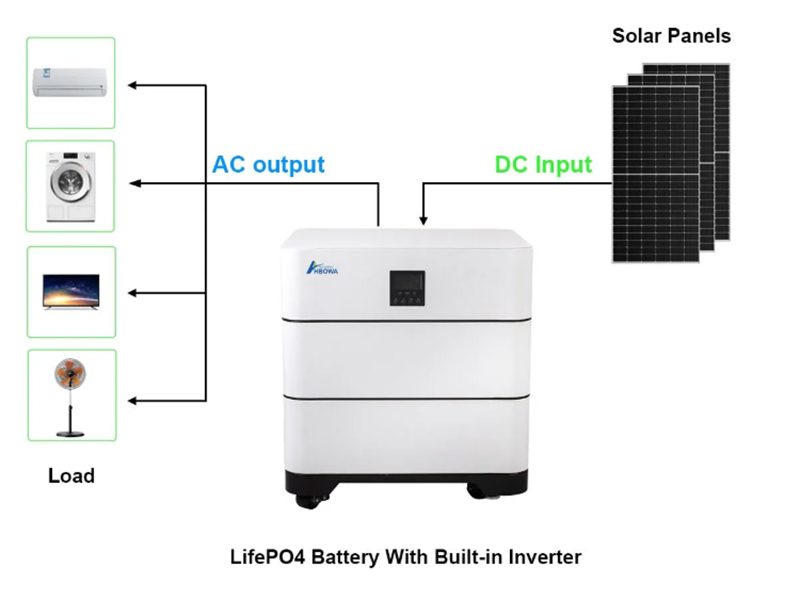
DC-coupled systems are ideal for new PV-plus-storage installations; they connect both the PV array and the battery energy storage system to the DC side of a hybrid inverter. Solar energy can charge the battery via a DC/DC module without changing the form of energy. When the battery discharges, the DC energy from both the PV panels and the battery is converted into AC to power household loads. This type of PV coupling system is highly efficient because it requires only a single energy conversion step (DC→AC). This approach is particularly advantageous for self-consumption scenarios; excess solar power generated during the day can be stored in batteries for use at night, thereby significantly reducing electricity bills over the long term.
However, some products designed for new installations utilize a "PV inverter + battery inverter" configuration rather than a hybrid inverter. Although they may look similar and share installation methods, these products involve multiple AC/DC conversions—resulting in lower energy efficiency—and are essentially AC-coupled energy storage systems.
2.2 AC-Coupled Energy Storage Systems
In an AC-coupled system, the PV array and the battery storage system each have their own independent inverters. These inverters are connected on the AC side. This type of system is suitable for retrofitting existing grid-tied PV systems. For households that already have PV panels and inverters installed, adding a storage unit (battery + battery inverter) creates a PV-plus-storage system without requiring extensive rewiring, thereby lowering installation and hardware costs. However, AC-coupled systems are less energy-efficient than DC-coupled systems, with energy losses of approximately 8%. This is because the process of moving energy from PV generation to the battery and then to household consumption requires three conversions in an AC-coupled system (DC→AC, AC→DC, and DC→AC), whereas a DC-coupled system requires only one (DC→AC).
Given that the typical lifespan of these products is 5–10 years, the cumulative energy loss in an AC-coupled system can be substantial. Therefore, for new installations, a DC-coupled system with a hybrid inverter is recommended to achieve optimal energy efficiency and maximize self-consumption and energy self-sufficiency.
(For more details on "self-consumption" and "self-sufficiency," please visit: https://www.alphaess.com/unlocking-energy-independence-with-alphaess:-maximize-self-consumption-and-self-sufficiency-with-advanced-solar-solutions)
2.3 Hybrid-Coupled Energy Storage Systems
Hybrid-coupled systems combine AC and DC coupling. For households with existing PV systems, this approach allows for expanded PV capacity by connecting additional PV panels directly to a hybrid inverter and adding a battery storage system, thereby optimizing PV utilization in retrofit scenarios. For users upgrading their photovoltaic systems to PV-battery energy storage systems (PV-BESS), both AC-coupled and hybrid-coupled configurations allow for the reuse of existing equipment. The key difference is that hybrid-coupled systems can accommodate additional PV panels, thereby increasing PV capacity and power generation.